
HELOC
A revolving line you draw from as needed. Flexible access, often with a draw period.
HELOC
A Home Equity Line of Credit lets homeowners borrow against available home equity. Before comparing HELOC amounts, payments or terms, the first step is understanding approximately how much equity you have.
Educational information only. No account, no phone number, no obligation.

Everything starts with understanding your home equity. Home equity is generally the difference between the estimated current value of your home and the remaining mortgage balance.
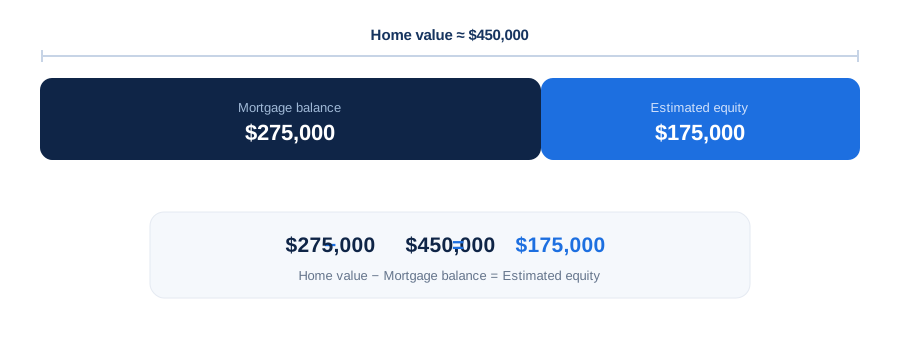
Example: estimated home value $450,000 − mortgage balance $275,000 = estimated equity $175,000.
Important: this does not mean a homeowner can necessarily borrow $175,000. Available borrowing depends on lender requirements, loan-to-value limits, credit profile, income, property characteristics and other underwriting factors. This is educational information, not an approval.
HELOC stands for Home Equity Line of Credit. It is generally a revolving line of credit secured by the homeowner's property. Unlike receiving one lump sum, a HELOC can let the borrower access funds as needed during the draw period, subject to the HELOC's terms and the available credit on the line.
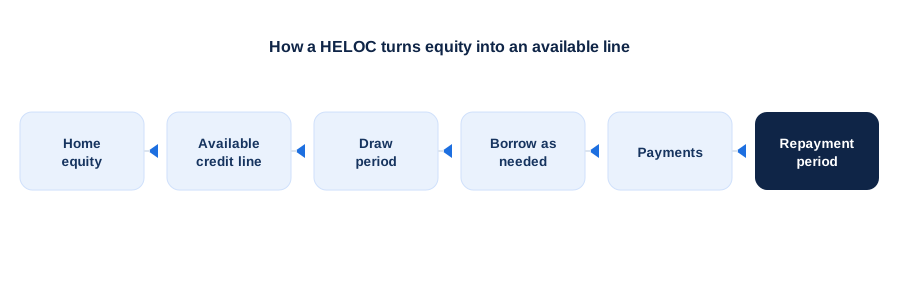
Because a HELOC is built on home equity, the size and availability of the line depend on how much equity you have. Before estimating what a HELOC could look like, understand your home equity.
The HELOC lifecycle usually follows a sequence of stages. The exact details vary by lender and product, so treat this as the general shape of how a HELOC works rather than a fixed set of terms:
Lender-specific terms are not universal. Draw periods, repayment structures and payment rules differ, so always check the terms of the specific HELOC you are considering.
The HELOC draw period is the window during which you can access the available funds on your line. During this time you can typically make multiple draws when permitted, repay what you use, and in many cases borrow again. Payments during the draw period may be structured in different ways depending on the lender and product.
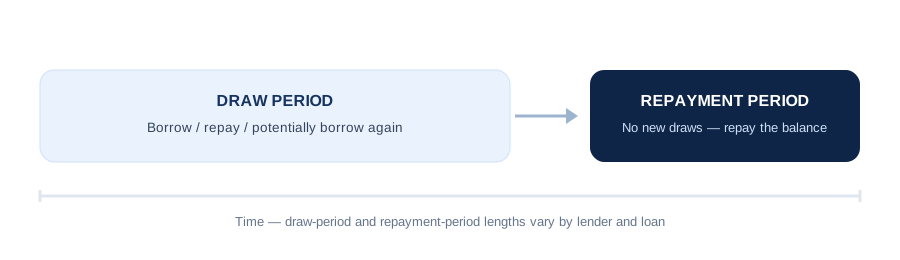
It matters to know when the draw period ends, because that transition changes how the line behaves. Exact durations and terms vary by lender and product — there is no single standard.
Some HELOCs may have payment structures during the draw period that allow or require interest-only payments. In that structure, a payment during the draw period is primarily based on interest on the amount you have drawn, rather than reducing principal. In short, a HELOC interest only payment covers the cost of borrowing on what you have drawn, rather than paying down what you owe.
Why this matters:
A lower payment during the draw period does not necessarily represent the eventual repayment-period payment. When repayment begins and principal is included, the payment can rise.
Not every HELOC operates identically. Whether interest-only payments are available, and under what conditions, depends on the lender and the specific loan terms.
One of the most useful concepts to understand is the payment transition. When the draw period ends, the structure of the payment can change:
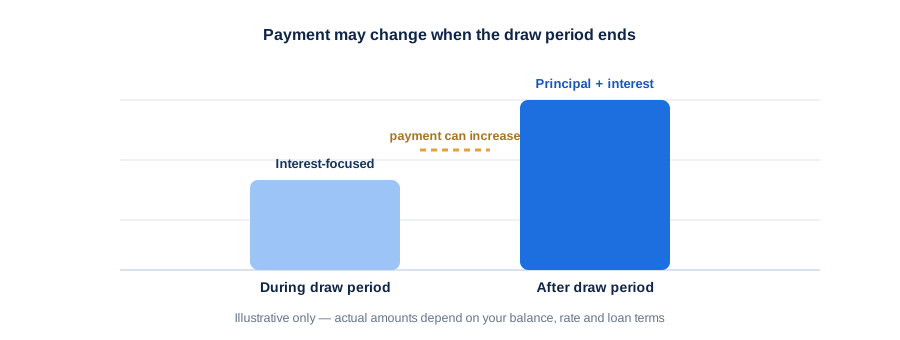
A payment may be interest-focused, which keeps it lower.
Repayment generally includes principal + interest, so the monthly payment may increase.
This potential increase is sometimes described as payment shock. It is a normal feature of how some HELOCs are structured, and it is simply worth understanding in advance so you can plan for it.
A useful HELOC payment calculator would eventually help estimate:
Before calculating HELOC payments, start by understanding your estimated home equity — it is the prerequisite that sets the ceiling for the line.
Calculate My Home Equity First
This page explains the concepts. It does not calculate HELOC payments for you. Treat any figures as illustrative rather than an offer or an approval.
Lenders may consider several factors when evaluating a HELOC. At a high level these can include:
Specific thresholds vary by lender and are not universal, so we do not publish approval criteria or tell you whether you qualify. What we can say is that the first measurable variable is home equity.
A HELOC is only one way to access home equity. The three common approaches differ mainly in how you receive the money and how you repay it.
A revolving line you draw from as needed. Flexible access, often with a draw period.
A single lump sum with a fixed repayment schedule. HELOC vs home equity loan →
Replace your mortgage with a larger one and take the difference in cash. Cash-out refinance →
Specialised comparison pages are coming; the links above are placeholders for now.
Before comparing HELOC limits, payments or borrowing options, understand approximately how much equity you currently have in your home.