
Cash-Out Refinance
Turn Part of Your Home Equity Into Cash
A cash-out refinance replaces your existing mortgage with a new, larger mortgage. The difference — after applicable costs and payoff amounts — may provide cash you can use for your financial goals. How much cash is available depends partly on your home equity and lending requirements.
Educational information only. No account, no phone number, no obligation.

Start With Your Home Equity
Everything starts with understanding your home equity. It is generally the difference between your home's estimated value and your current mortgage balance.
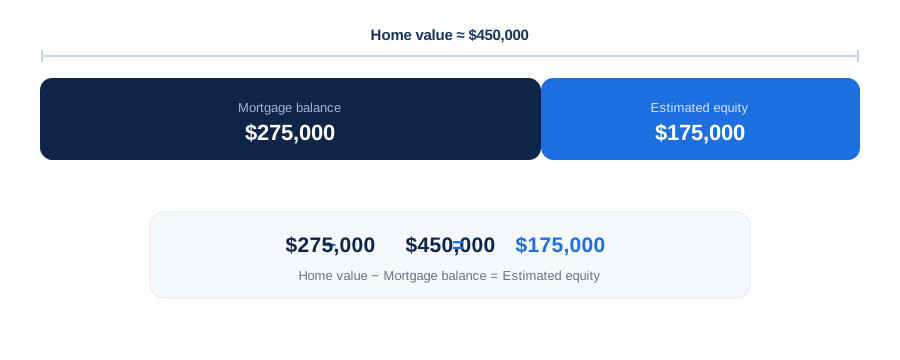
Example: estimated home value $450,000 − mortgage balance $275,000 = estimated equity $175,000.
Important: $175,000 of estimated equity does not necessarily mean you can receive $175,000 in cash. Actual borrowing capacity depends on factors including lender loan-to-value limits, credit, income, the property, your mortgage balance, closing costs and underwriting requirements.
How Does a Cash-Out Refinance Work?
A cash-out refinance replaces your existing first mortgage. You take out a new, larger mortgage, the old mortgage is paid off, and the difference may become available to you as cash after applicable costs and adjustments.
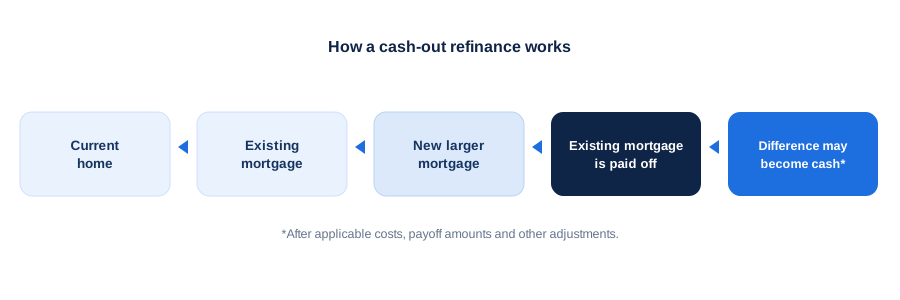
This is the key difference from a HELOC: a cash-out refinance generally replaces your existing first mortgage. It does not simply add a separate cash account while leaving the original mortgage unchanged.
What Can Cash-Out Refinance Funds Be Used For?
Homeowners investigate cash-out refinancing for many reasons. Common examples include:
- consolidating debts
- paying higher-interest credit-card balances
- paying off other loans
- home improvements
- major planned expenses
- education expenses
- other financial goals
Important trade-off: using home equity this way converts part of your equity into mortgage debt secured by your property. It is not automatically financially beneficial.
Using Home Equity to Consolidate Debt
A homeowner may be carrying several balances at once — a mortgage, credit cards, personal loans and other debts. A cash-out refinance may provide a lump sum that can potentially be used to pay some of those balances. This is often called cash out refinance for debt consolidation.
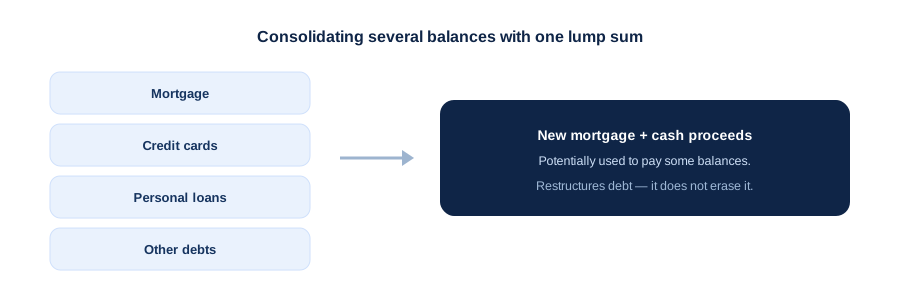
Why people consider it: some unsecured debts, particularly credit cards, may carry higher interest rates than mortgage financing. However, refinancing does not automatically save money.
Important considerations if you are weighing a cash out refinance to pay off debt or a cash out refinance to pay credit cards:
- your current mortgage rate versus a new mortgage rate
- closing costs
- the loan term and amount borrowed
- total interest over time
- converting unsecured debt into debt secured by your home
- whether the credit-card balances actually stay paid off afterward
Keep in mind that debt consolidation restructures debt — it does not eliminate it.
Cash-Out Refinance vs HELOC
These two options are structured quite differently. Here is the cash out refinance vs HELOC comparison at a glance:
Cash-Out Refinance
- generally replaces the existing mortgage
- creates a new mortgage balance
- may provide proceeds as a lump sum after closing
- you receive the cash rather than drawing from a line
- mortgage terms and rate may change
HELOC
- normally exists alongside the existing first mortgage
- provides a revolving credit line
- funds may be drawn as needed during the draw period
- commonly has variable-rate characteristics
- payments can change
There is no universally better option — the appropriate structure depends on your situation, your existing mortgage rate, how much you need and how you expect to use it.
Lump Sum vs Line of Credit
The way you receive the money is an important difference:
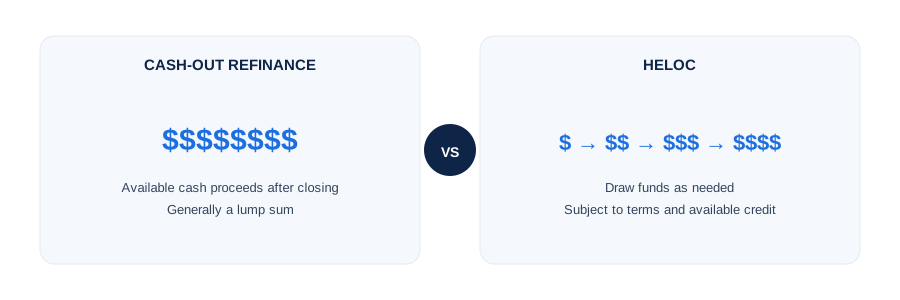
Someone who needs a defined amount for debt consolidation may evaluate these options differently from someone who expects expenses over time. Neither product is universally better.
What Happens to My Existing Mortgage?
A cash-out refinance is a refinance. Your existing mortgage is generally paid off and replaced with the new mortgage. That means it is worth considering more than just how much cash you can receive. Compare:
- your existing mortgage rate versus a potential new rate
- your remaining mortgage term versus a new loan term
- your monthly payment
- closing costs
- total borrowing cost
- break-even considerations
This matters especially if you already have a favorable existing mortgage rate.
Costs and Considerations
Cash-out refinancing may involve costs. Potential considerations include:
- closing costs
- appraisal / valuation requirements where applicable
- lender fees
- interest rate
- new loan amount
- mortgage term
- monthly payment
- total interest
- available equity and loan-to-value requirements
- credit / income underwriting
Specific fees and thresholds vary by lender; we do not publish lender-specific figures.
How Much Cash Could I Potentially Access?
The answer begins with home equity — but it is not simply equity = available cash:
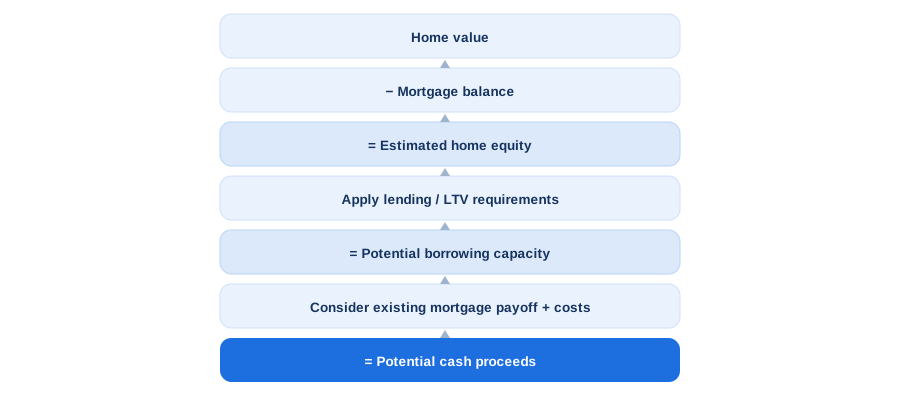
The exact amount requires actual loan terms and underwriting. Start with your estimated equity:
Cash-Out Refinance Calculator
A useful cash out refinance calculator would eventually help evaluate:
- estimated home value and mortgage balance
- estimated equity
- a desired cash amount
- your existing mortgage rate and a potential new rate
- your current payment and an estimated new payment
- closing costs and break-even considerations
Before calculating a cash-out refinance scenario, start with your estimated home equity.
Cash-Out Refinance Rates Today
Questions about cash out refinance rates today are common — but rates change constantly and depend on the borrower, the property, the market and the loan characteristics. We do not publish a fixed rate here, because a figure that was accurate last week could mislead you today.
Why the rate matters especially for a cash-out refinance: the new rate generally applies to the entire new mortgage balance, not merely to the amount of cash taken out.
Future functionality may provide current Florida rate information. Until then, treat any rate as illustrative and confirm it with your lender.
Is Cash-Out Refinancing Right for Every Homeowner?
No — it is not automatically the right solution simply because equity exists. Relevant considerations include:
- the reason for accessing cash
- the amount needed
- your existing mortgage rate versus a new rate
- how long you expect to stay in the home
- closing costs
- your ability to repay
- alternatives such as a HELOC or a home equity loan
This is educational information; it is not individualized financial advice and does not guarantee suitability.
Common cash-out refinance questions
- How does a cash out refinance work, in one sentence?
- It replaces your existing mortgage with a new, larger mortgage and may provide the difference as cash after applicable costs and payoff amounts.
- Cash out refinance vs HELOC — which is better?
- Neither is universally better. A cash-out refinance replaces your mortgage and gives a lump sum; a HELOC sits alongside your mortgage and gives a revolving line you draw from as needed.
- Can I use a cash out refinance to pay off credit cards?
- Potentially, yes — proceeds may be used to pay balances. Be aware this converts unsecured debt into debt secured by your home, and it restructures rather than eliminates debt.
- How much equity do I have?
- Estimate it as your home value minus your mortgage balance, then confirm your situation with the Home Equity Calculator.
- How to get equity out of my house?
- Common routes are a cash-out refinance, a HELOC, or a home equity loan. Which fits depends on your goal and your existing mortgage rate.
Start With Your Home Equity
Before deciding whether a cash-out refinance, HELOC or another option makes sense, understand approximately how much equity you currently have.