
Home equity, explained
Understand Your Home Equity
Home equity is the portion of your home you effectively own — the difference between what your home is worth and what you still owe on your mortgage. Understanding it is the first step before exploring a HELOC or any other way to access it.
Educational information only. No account, no phone number, no obligation.

What Is Home Equity?
Home equity is the part of your home's value that you have effectively paid off. As you pay down your mortgage — and as your home's value changes — your equity moves. A simple way to estimate it:
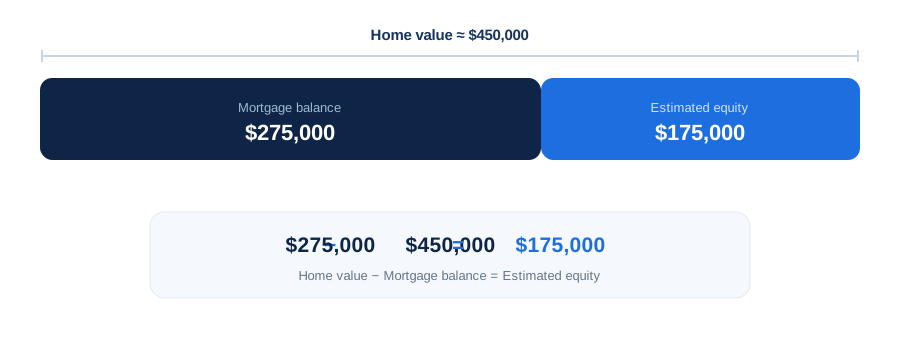
For example: if a home is worth approximately $450,000 and the mortgage balance is $275,000, then $450,000 − $275,000 = $175,000 of estimated equity.
Important: this is a simplified equity estimate. It does not mean you can necessarily borrow the entire amount. Lenders consider several factors, and home values and balances change over time.
The easiest way to start is by estimating how much equity you have in your own home: Estimate Your Home Equity.
How Does a HELOC Work?
A HELOC is a Home Equity Line of Credit. It is a revolving line of credit secured by your home equity — closer in spirit to a credit card tied to your house than to a single lump-sum loan. Instead of receiving one fixed amount, you are approved for a line you can draw from as needed, repay, and often draw from again during the draw period.
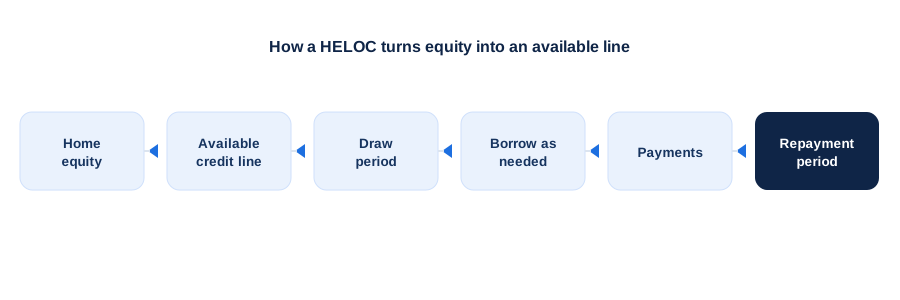
Because a HELOC is backed by your equity, the size of the line is tied to how much equity you have. That is why understanding your estimated equity comes first — not sure how much equity you have? Calculate your home equity.
What Is a HELOC Draw Period?
The HELOC draw period is the window during which you can access the funds on your line of credit. During this period you can typically borrow as needed rather than taking everything at once, repay what you use, and in many cases borrow again. Payments during the draw period commonly cover the interest on what you have borrowed, though this depends on the lender and your loan terms.
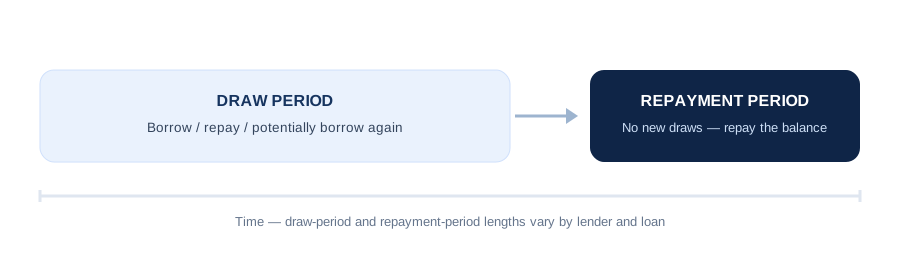
When the draw period ends, the line enters the repayment period: you can no longer draw new funds, and you repay the outstanding balance according to the loan terms.
Draw-period and repayment-period lengths and rules vary by lender and by loan. Treat any duration you see as an example, not a universal standard.
How Do HELOC Interest-Only Payments Work?
Some HELOC structures allow or require payments during the draw period that are primarily or only based on interest. Often called a HELOC interest only payment, this keeps the payment lower because you are not yet paying down principal — you are covering the cost of borrowing on the amount you have drawn.
This is convenient while it lasts, but there is a catch:
A lower payment during the draw period does not necessarily mean the payment stays at that level. When repayment begins and principal is included, the payment can rise.
Whether interest-only payments are available, and under what conditions, depends on the lender and loan terms. If a payment figure is shown anywhere, treat it as illustrative until it is confirmed in your actual loan documents.
What Happens to a HELOC Payment After the Draw Period?
This is one of the most important things to understand before borrowing. When the draw period ends, the structure of your payment can change:
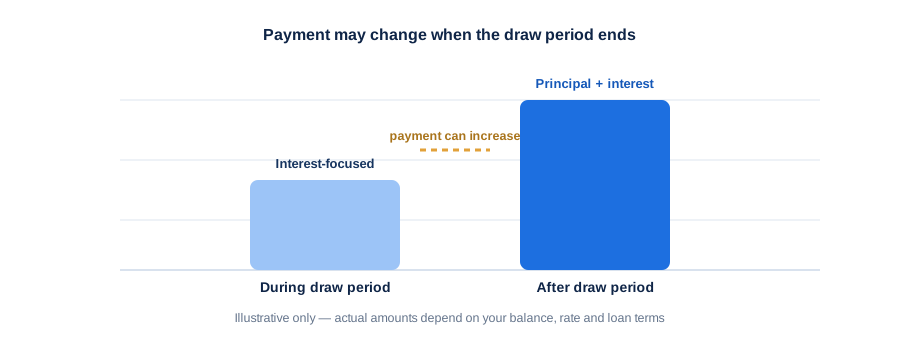
During the draw period
A payment may be interest-focused, which keeps it lower.
After the draw period
Repayment generally includes principal + interest, so the monthly payment can increase.
That potential jump — sometimes called payment shock — is exactly why it is worth modelling the whole picture before you borrow, not just the draw-period payment.
How Does a HELOC Payment Calculator Help?
A useful HELOC payment calculator helps you see the whole picture rather than a single number. It can help you understand:
- the estimated payment on an amount drawn
- the balance you would be paying on
- the interest-rate assumptions used
- the draw-period payment
- the repayment-period payment
- the possible payment change after the draw period
Before estimating a HELOC payment, it helps to know roughly how much equity you have — that sets the ceiling for what a line of credit could reasonably be based on.
This page explains the concepts. It does not calculate a HELOC payment for you yet — treat any figures you see as illustrative rather than an offer or an approval.
Common questions about home equity and HELOCs
- How does a HELOC work, in one sentence?
- It turns your available home equity into a revolving line of credit you can draw from during the draw period and repay later, instead of receiving a single lump sum.
- How long does a HELOC draw period last?
- It varies by lender and loan. Some draw periods are several years, but there is no universal duration, so check the terms of the specific line you are considering.
- Is a HELOC interest only payment always available?
- No. Whether interest-only payments are offered during the draw period depends on the lender and the loan terms, and the payment can change once repayment begins.
- Will my HELOC payment after the draw period be higher?
- It can be. Once the draw period ends and repayment includes principal as well as interest, the monthly payment may increase. Modelling it in advance helps you prepare.
- Can I borrow all of my home equity?
- Usually not. An equity estimate is a starting point, not a borrowing limit. Lenders weigh several factors, and the amount available is generally a portion of your equity.
- Will the HELOC payment after draw period go up?
- Often, yes. The HELOC payment after draw period can be higher than the interest-focused payments during the draw period, because you are now repaying principal as well as interest — the amount depends on your balance, rate and loan terms.
- What should I do first?
- Understand your estimated equity. It is the logical starting point before comparing ways to access it. Use the Home Equity Calculator.
How Much Equity Do You Have?
Understanding your home's estimated equity is the logical first step before comparing ways to access it. Start there, then explore your options with confidence.